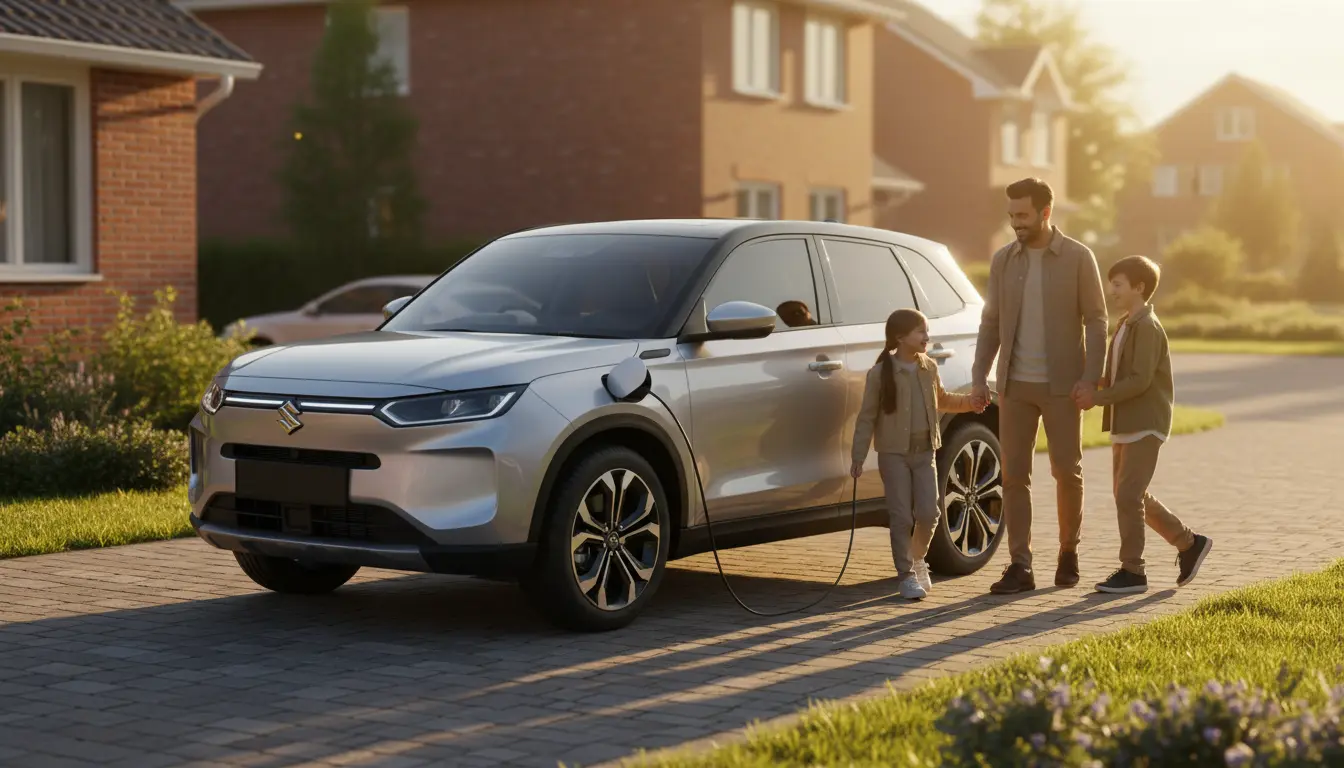
What the 2026 Maruti Suzuki e Vitara means for families
The 2026 Maruti Suzuki e Vitara aims to be a practical, smart electric SUV built for modern family life. It focuses on usable cabin space, safety, and manageable running costs rather than pure performance showmanship.
This article explains the key features, expected range and charging behavior, interior practicality, safety tech, ownership costs, and a short real-world case study for everyday buyers.
Overview of the 2026 Maruti Suzuki e Vitara

The e Vitara is positioned as a compact family SUV with a full-electric powertrain. It follows current industry trends: a middle-size battery pack, DC fast charging support, and connected vehicle technologies.
Key expected highlights include a roomy cabin, modular seating for family needs, and a safety suite intended for everyday driving scenarios.
Expected features and highlights
- Seating for five with flexible rear-seat layouts and a large boot area suitable for strollers and weekend luggage.
- Smart connected features: OTA updates, app-based remote functions, navigation with charging station guidance.
- Driver-assistance technologies such as lane-keep assist, adaptive cruise control, and automatic emergency braking.
- Support for AC home charging and DC fast charging for longer trips.
Battery, range, and charging for the e Vitara
Range and charging are central to usability. The e Vitara is expected to offer a practical real-world range that covers typical family patterns like school runs and weekly outings.

Typical electric-SUV setups in this segment include a battery sized for 250–400 km real-world range, depending on driving style and conditions. Fast charging capability should allow 0–80% charge in roughly 30–45 minutes on a DC fast charger.
Charging at home and on the road
Home charging overnight will be the most convenient option for many families. A dedicated AC wall box can restore a full charge in several hours, making morning departures simple and stress-free.
On long trips, public DC fast chargers shorten stops. Plan journeys using the car’s navigation or a charging app to ensure chargers are available along your route.
Interior, space and practicality

Families need usable space rather than headline cargo numbers. The e Vitara should emphasize cabin ergonomics with easy-access ISOFIX points and clever storage solutions.
Materials are likely to focus on durable, easy-to-clean surfaces for family life. Rear-seat comfort and a flat floor (common in EVs) help with child seats and legroom for older kids.
Safety and driver assistance in the e Vitara
Safety will be a key selling point. Expect a full suite of active and passive safety features aimed at family buyers. These include multiple airbags, electronic stability control, and modern ADAS functions.
Before purchase, check official crash-test ratings and the exact ADAS feature set available for your market and trim level.
Ownership costs and incentives
One of the strongest appeals of an electric family SUV is lower operating costs. Electricity often costs less per kilometer than petrol, and EVs typically have fewer moving parts to maintain.
Costs depend on local electricity prices, charging habits, and potential government incentives or subsidies. Factor in charger installation at home and possible higher insurance costs for new EV tech.
Practical checklist before buying
- Confirm realistic range for your driving habits and local climate.
- Assess home charging feasibility and installation cost.
- Compare trim levels for essential safety and child-friendly features.
- Check local incentives, registration rules, and warranty for battery packs.
Modern compact electric SUVs typically provide a flat cabin floor that simplifies child seat installation and increases usable foot space for rear passengers. This is a direct advantage of EV architecture for families.
Real-world example: A family test case
Case study: The Sharma family in Pune has two young children and a daily commute of 30–40 km round trip. They also take monthly weekend trips of 200–300 km.
Using an e Vitara with a practical 300 km real-world range, their routine works like this:
- Home overnight charging restores a full battery, sufficient for daily driving without topping up.
- Weekend trips use one DC fast-charge stop or a longer break while having lunch, keeping total travel time comparable to a petrol car.
- The family finds lower weekly fuel spending and quieter cabin comfort beneficial for children during drives.
Note: This example uses conservative usage patterns and is for illustration. Exact costs and range will vary by model, driving style, and climate.
Buying tips for the 2026 Maruti Suzuki e Vitara
When considering the e Vitara, test drive it with the seating and cargo you normally use. Bring child seats and luggage to ensure the layout works for your family’s routines.
Ask dealers about local charging support, bundled home charger options, and real-world efficiency numbers from current owners or fleet tests.
Conclusion: Is the e Vitara right for modern families?
The 2026 Maruti Suzuki e Vitara appears aimed at families who want a practical, connected, and lower-cost-to-run compact electric SUV. It prioritizes daily usability, safety, and straightforward charging rather than extreme range or sporty performance.
If your driving pattern includes regular home charging and mixed local and weekend trips, the e Vitara could be a strong family choice. Always compare real-world range figures, safety ratings, and ownership support before finalizing a purchase.