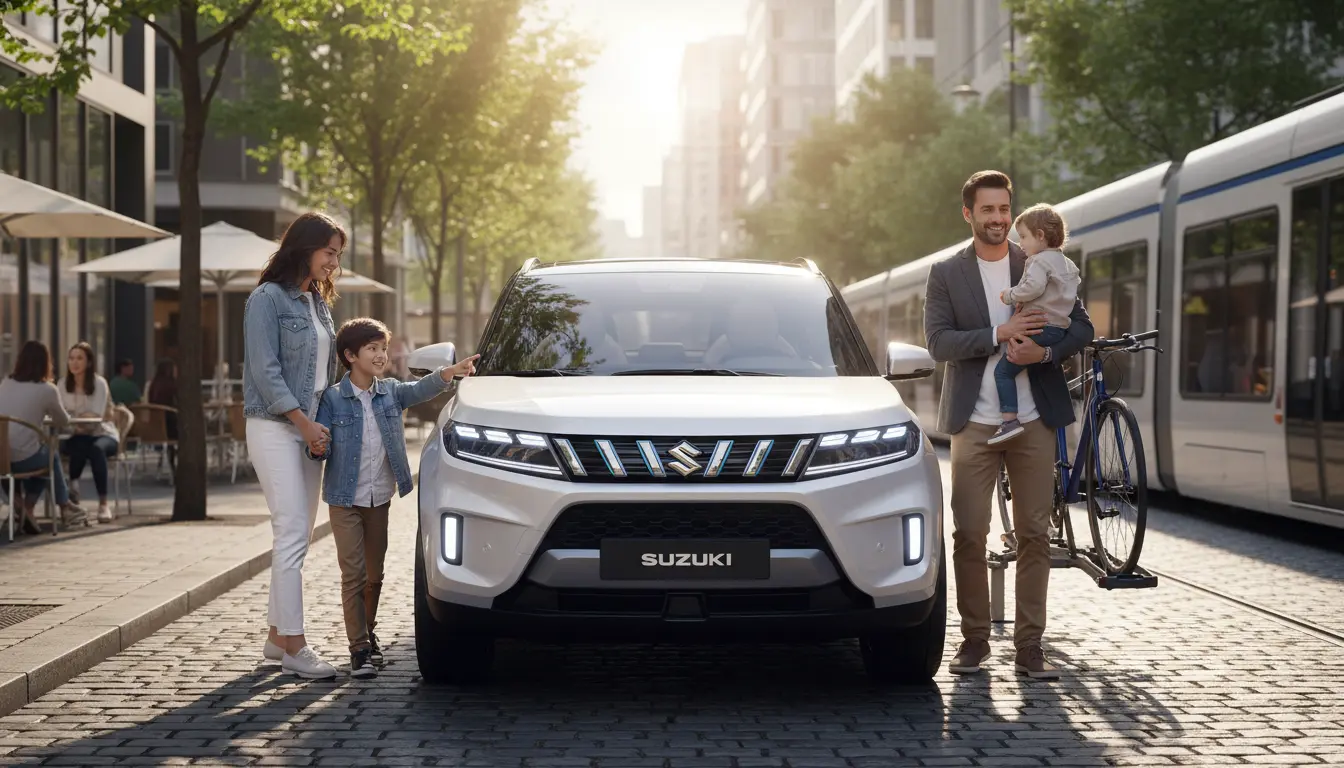
Overview of the 2026 Maruti Suzuki e Vitara
The 2026 Maruti Suzuki e Vitara is a compact electric SUV aimed at families who need space, efficiency, and simple smart features. It balances daily usability with an electric drivetrain tuned for urban and suburban driving.
This article explains the key features, realistic range expectations, costs, safety systems, and practical tips for families considering the e Vitara.
2026 Maruti Suzuki e Vitara Battery and Range

The battery pack on the 2026 Maruti Suzuki e Vitara is positioned for family use rather than high-performance driving. Expect a battery capacity in the 45–60 kWh range depending on trim, which is a common size for compact family EVs.
Projected range is 300–420 km on a single charge under mixed driving conditions. Real-world range varies with speed, climate control use, and load.
Charging options and times for the 2026 Maruti Suzuki e Vitara
- AC home charging (7–11 kW): 6–10 hours for a full charge, convenient overnight.
- Public fast AC chargers (22 kW): 2–3 hours for a full charge, useful for day trips.
- DC fast charging (up to 100 kW): 30–45 minutes to 80% depending on battery size and state of charge.
Interior and Family Features of the e Vitara
The e Vitara focuses on practical family features: flexible seating, simple infotainment, and storage solutions for everyday life. Interior materials are durable and easy to clean.

Key family-friendly features include a flat rear floor in some trims, ISOFIX child seat anchors, and a roomy boot with adjustable cargo floor options.
Technology and connectivity
- 8–10 inch touchscreen infotainment with smartphone integration (Apple CarPlay and Android Auto).
- Over-the-air updates for basic software and navigation improvements.
- Connected app for range monitoring, remote pre-conditioning, and charge scheduling.
Safety and Driver Assistance in the 2026 Maruti Suzuki e Vitara
Safety for family vehicles is essential. The e Vitara is expected to include multiple airbags, stability control, and a reinforced body structure to protect occupants in common crash scenarios.
Driver assistance systems are likely to include adaptive cruise control, lane-keeping assist, automatic emergency braking, and blind-spot monitoring on higher trims.
Practical safety notes
- Check the specific variant for available ADAS features; base trims may omit some advanced systems.
- Consider optional safety packages if you do a lot of highway driving or carry children frequently.
Costs, Incentives, and Ownership Tips

Electric vehicles often have lower running costs than petrol cars. The e Vitara benefits from simpler maintenance (no oil changes) and lower per-kilometre energy costs if you charge at home.
Purchase price and local incentives will affect total cost of ownership. Look for government subsidies, lower registration fees, and tax benefits where available.
Realistic ownership guidance
- Estimate yearly charging cost by multiplying your annual km by the car’s consumption (kWh/100 km) and local electricity price.
- Plan for battery health: keep state of charge between 20% and 80% for daily use and avoid frequent deep discharges.
- Use scheduled charging during off-peak hours to reduce electricity bills.
Charging an EV at home overnight typically costs much less than filling a petrol car. For many families, this reduces weekly running costs by 30–60% depending on local fuel and electricity prices.
Practical Tips for Families Considering the 2026 Maruti Suzuki e Vitara
Families should evaluate daily driving habits and charging access before deciding. For urban families with overnight home charging, the e Vitara is convenient and cost-effective.
If you frequently travel long distances on highways, check exact range figures and available DC fast charging performance on the model you plan to buy.
Checklist before buying
- Confirm real-world range for the trim and wheel size you want.
- Test a full day of family use including shopping, school runs, and a short highway trip.
- Ensure you have reliable access to home or workplace charging.
Real-World Example: A Small Family Test Drive
Case study: A family of four in Pune used the e Vitara for one week to test daily needs. They did school runs, a 70 km round-trip to a weekend park, and grocery trips.
With the 50 kWh battery trim, they averaged about 340 km of usable range per full charge using AC climate control and mixed city-highway driving. Home charging overnight restored a full battery each day, and DC fast charging was unused during the week.
The family cited easy entry for kids, good cargo space for strollers, and the connected app for pre-cooling as major benefits. They recommended the e Vitara for families with predictable daily routes and access to home charging.
Competitors and Market Position
The 2026 Maruti Suzuki e Vitara competes with other compact electric SUVs that target families. Its strengths are likely to be price, service network, and practical packaging rather than premium features.
Compare total cost of ownership, available warranties, and dealer support when choosing between similar models.
Conclusion
The 2026 Maruti Suzuki e Vitara is a practical electric SUV option for modern families who want efficiency, space, and simple smart features. It is best suited to households with predictable daily mileage and access to regular charging.
Before buying, verify the specific trim’s range, charging performance, and safety features. A targeted test drive that mimics your routine will reveal whether the e Vitara fits your family life.