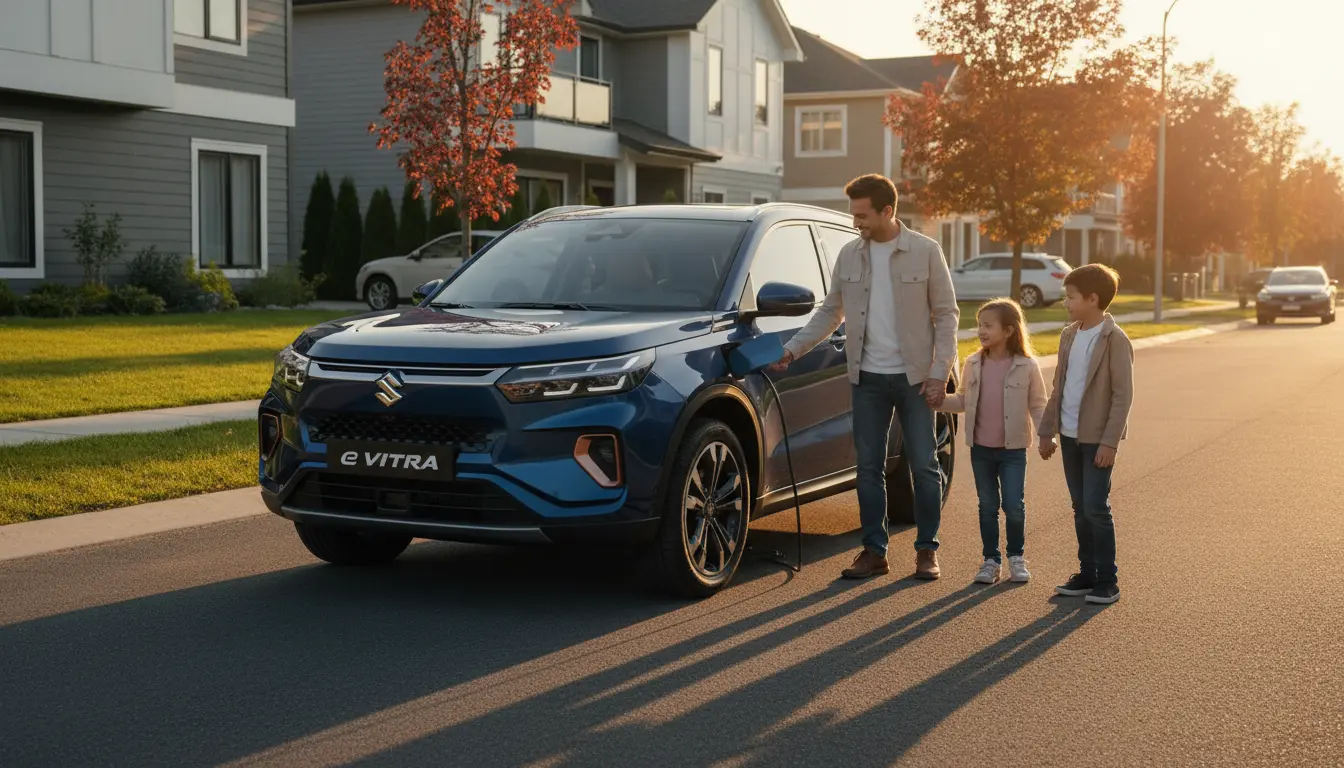
Overview of the 2026 Maruti Suzuki e Vitara
The 2026 Maruti Suzuki e Vitara is a compact electric SUV positioned for modern family use. It combines pragmatic interior space with an emphasis on efficiency and connected features.
This guide explains the e Vitara’s key specs, daily usability, costs, and how it fits typical family needs. Use this when comparing models or planning ownership.
Key specifications and performance of the 2026 Maruti Suzuki e Vitara
The e Vitara comes with a battery pack sized for urban and suburban driving. Official range figures target daily family use rather than long-distance touring.
Powertrain options include a single-motor setup tuned for easy city driving and responsive throttle control. Regenerative braking and selectable drive modes maximize efficiency.
Battery, range, and charging
The model offers an estimated real-world range of about 300–420 km depending on trim and driving conditions. City range is generally higher due to lower steady-state speeds and regenerative gains.

Charging supports AC home charging and faster DC fast charging for public stations. Typical home charge time (0–100%) is 6–10 hours on a 7 kW charger while fast charging 20–80% can take 30–50 minutes depending on the station and battery state.
Interior space and family usability
Interior design focuses on flexible seating and practical storage. Rear legroom and boot volume are arranged to carry child seats, strollers, and groceries with ease.
Examples of family-friendly features include ISOFIX anchors, rear AC vents, and multiple USB ports for rear passengers. Materials prioritize durability and easy cleaning.
Technology and safety in the e Vitara
The car includes a modern infotainment system with smartphone integration and over-the-air (OTA) update capability. Navigation takes into account charging stops for route planning.
Active safety features typically present on the e Vitara include automatic emergency braking, lane keep assist, and adaptive cruise control. These systems reduce driver workload in daily traffic.
Connectivity and smart features
Remote app control lets owners check battery level, schedule charging, and pre-condition the cabin temperature. This is useful for cold mornings or hot afternoons with children on board.
Driver assistance features are designed for commuter convenience rather than full autonomy. They provide predictable behavior and clear warnings.
Costs, incentives, and running expenses
Purchase price will vary by country and local incentives. Electric models often qualify for tax credits, rebates, or reduced registration fees which lower effective cost.
Running costs for the e Vitara focus on lower energy and maintenance expenses compared with petrol SUVs. EVs have fewer moving parts and lower scheduled service costs.
- Lower cost per kilometer in electricity vs petrol
- Reduced maintenance on brakes due to regenerative braking
- Potential government incentives and home charger rebates
Practical considerations for families
When evaluating the e Vitara, consider charging access at home and near common routes such as schools, workplaces, and shopping centers. A home wallbox adds convenience.
Assess seating needs and cargo habits. Roof rails and fold-flat rear seats increase versatility for weekend trips and family gear.
Parking and urban use
The compact footprint makes city parking and maneuvering easier than larger SUVs. Electric torque provides smooth low-speed acceleration for congested roads.
Noise reduction in the cabin helps reduce fatigue on short trips, which is helpful with children aboard.
Real-world example: A family week with the e Vitara
Case study: The Sharma family uses the e Vitara for a typical week: school drop-offs, grocery runs, and a one-hour weekend outing. Their daily commute is 35 km round trip.
After installing a 7 kW home charger, they set a nightly charge schedule and pre-cool the cabin before leaving. The family reports enough range for a full week without midweek public charging.
Key benefits they noted were lower running costs, quieter rides, and simplified maintenance visits. They also used the car’s app to monitor battery and schedule charging at cheaper tariff hours.
Pros and cons summary for the 2026 Maruti Suzuki e Vitara
Below is a concise list to help decision making. These points focus on family priorities like space, cost, and convenience.
- Pros: Efficient urban range, family-friendly layout, modern safety and connectivity, lower running costs.
- Cons: Limited ultra-long-range capability compared with larger EVs, public fast-charging network can vary by region.
Regenerative braking in the e Vitara can recover up to 15–20% of energy during urban stop-and-go driving, extending daily range without plugging in.
Buying tips and final thoughts
Test drive with family members and luggage to confirm space and comfort. Check local incentives and expected electricity tariffs to estimate total ownership cost.
Consider the availability of service centers and warranty coverage for the high-voltage battery. A good warranty reduces long-term uncertainty for family buyers.
Overall, the 2026 Maruti Suzuki e Vitara is a practical, family-oriented electric SUV designed for everyday use. It balances range, cost, and features in a package suited to modern family routines.