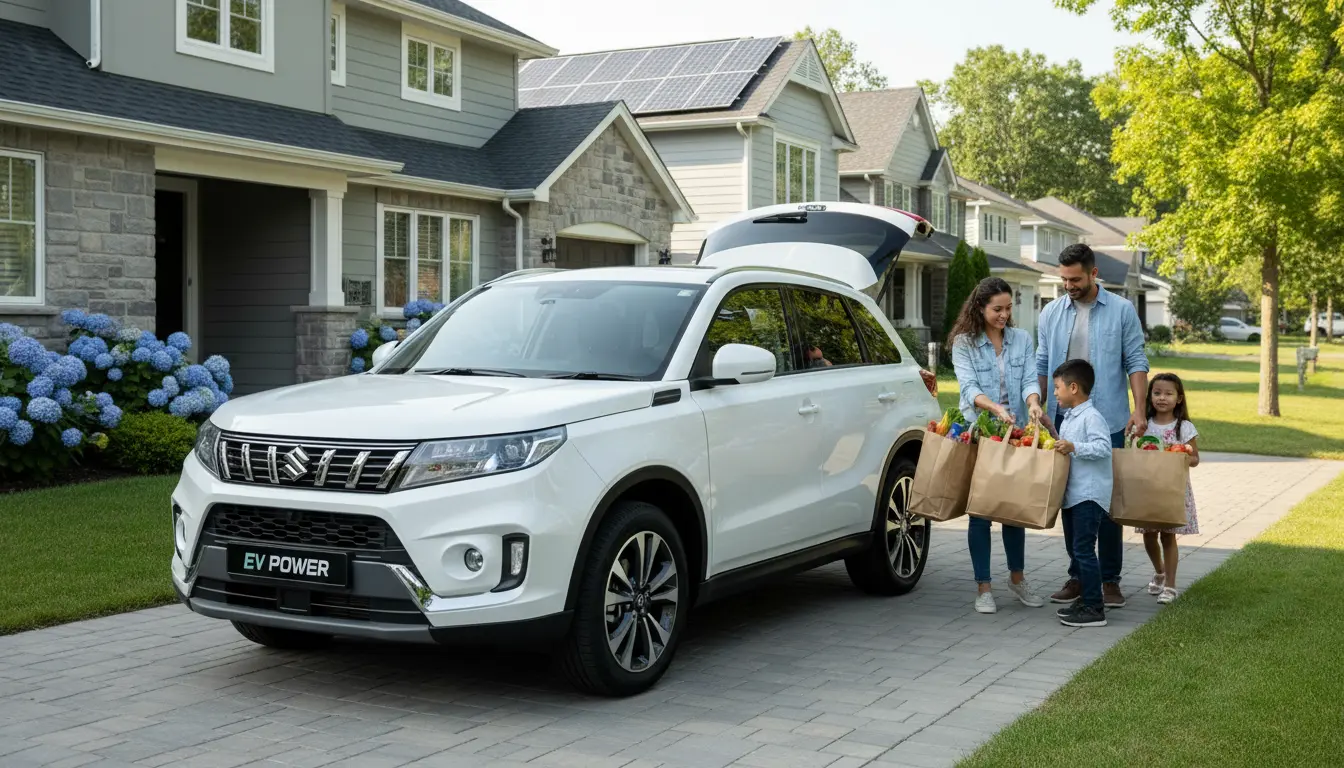
Overview: 2026 Maruti Suzuki e Vitara for modern families
The 2026 Maruti Suzuki e Vitara is positioned as a smart electric SUV for modern families. It aims to combine family-friendly space with efficient electric driving and useful technology.
This article explains the key features, real-world range, charging options, safety, cost of ownership and practical tips for family buyers.
Design and interior: Practical family space in the e Vitara
The e Vitara keeps a compact SUV footprint with a focus on usable interior space. Seats are arranged to give adults comfortable legroom and flexible cargo space for strollers or luggage.
Materials and layout emphasize durability and easy cleaning, an advantage for families with children. Storage cubbies, cup holders and ISOFIX anchors are standard in most trims.
Performance and electric range of the 2026 Maruti Suzuki e Vitara
The e Vitara uses a front-mounted electric motor tuned for smooth city driving and predictable highway behavior. Acceleration is adequate for daily family needs without aggressive tuning.

Range depends on battery options and driving conditions. Typical real-world range estimates are useful for planning family trips and daily school runs.
Typical specifications
- Battery options: mid-range and long-range (varies by market)
- Estimated real-world range: 250–420 km depending on battery and driving
- Charging: AC home charging and DC fast charging supported
- Power output: tuned for efficiency and smooth urban response
Charging and daily use for families
Most families will charge the e Vitara overnight at home using an AC charger. This is convenient and ensures a full range for the next day.
For longer trips, fast chargers reduce downtime. Knowing typical charging points on regular routes helps planning weekend drives or visits to relatives.
Charging tips
- Install a dedicated home charger (7–11 kW) for overnight convenience.
- Use DC fast charging on long trips; a 30–80% charge is usually the fastest window.
- Plan routes with reliable charging stations near family destinations like malls and highways.
Safety and family-friendly technology in the e Vitara
Modern families prioritize safety. The e Vitara includes passive and active safety systems designed for everyday driving and child protection.
Driver assistance features reduce stress in traffic and on highways. Accessible controls, clear displays and ergonomic seating contribute to safer journeys.
Key safety highlights
- Multiple airbags and ISOFIX child seat anchors
- ABS with EBD, stability control and brake assist
- Driver assistance: adaptive cruise control, lane-keeping assist, and parking sensors/camera
The average family in urban India drives less than 40 km per day, so many daily needs for the e Vitara can be met with a single overnight charge.
Cost of ownership: Running and maintenance
Electric vehicles typically have lower running costs than petrol cars due to cheaper energy per km and fewer moving parts. The e Vitara follows this trend.
Service items like tires, brakes and cabin filters remain, but regenerative braking reduces brake wear. Compare long-term electricity costs versus fuel for an accurate view.
Cost checklist
- Home charger installation cost
- Electricity cost per kWh in your area
- Expected maintenance savings versus ICE vehicles
- Battery warranty and replacement policies
Practical buying tips for families considering the 2026 Maruti Suzuki e Vitara
When evaluating the e Vitara, list how you use a car: daily commute, school runs, weekend trips, or long family vacations. This clarifies battery size and trim choice.
Test drives should include roads you use daily and a highway section. Check cabin comfort with typical child seats and cargo items you carry often.
Checklist before purchase
- Confirm real-world range for your typical route and climate.
- Check charging options at home and near common destinations.
- Review safety features and child seat compatibility.
- Compare trims for practical features like roof rails, boot layout, and rear-seat amenities.
Real-world example: A family using the e Vitara
Case study: The Gupta family in Pune upgraded to an e Vitara for school runs and weekend travel. Their daily driving averaged 35 km and weekly highway trips were about 150 km.
They installed a home AC charger and used fast chargers for longer trips. Over six months they reported lower monthly fuel-equivalent costs and simpler maintenance scheduling.
- Daily charging time: overnight 7 kW — full by morning
- Monthly energy cost: roughly half of previous petrol expenses (varies by tariff)
- Comfort: children found cabin quieter and boot met stroller and shopping needs
Conclusion: Is the 2026 Maruti Suzuki e Vitara right for your family?
The 2026 Maruti Suzuki e Vitara targets families who want a practical, efficient electric SUV with modern safety and convenience features. It is particularly strong for urban and suburban households with access to home charging.
Evaluate your daily mileage, charging access and long-trip needs. If those align with the e Vitara’s range and features, it can be a cost-effective and family-friendly choice.
For a final decision, test drive the exact trim you plan to buy and simulate a full day of your family routines to confirm fit, comfort and range expectations.