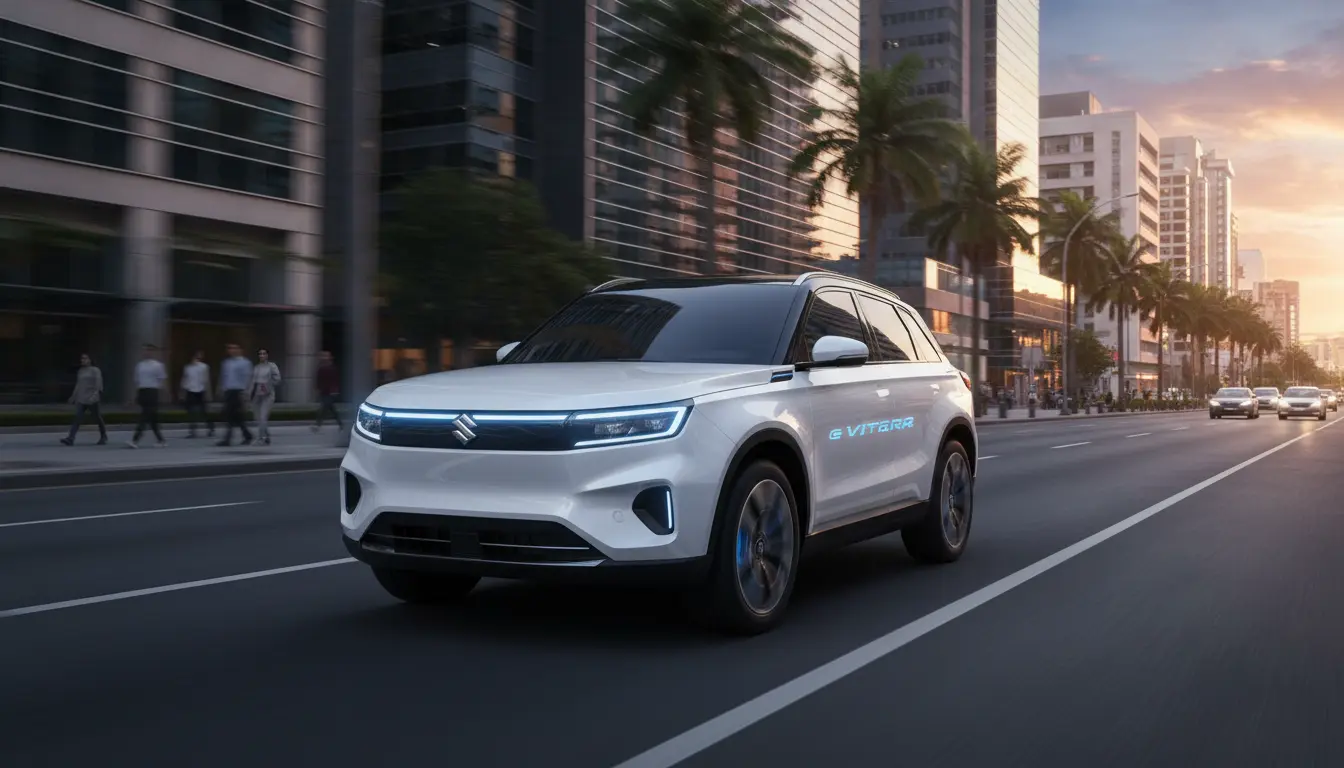
Overview of the 2026 Maruti Suzuki e Vitara
The 2026 Maruti Suzuki e Vitara is positioned as a compact electric SUV aimed at families who want daily practicality with low running costs. It combines an efficient electric powertrain with family-friendly packaging and modern safety aids.
This guide explains the practical points families should know: range, charging, interior space, safety, ownership costs, and buying tips.
Key specs and what they mean for families

The headline specs matter, but the real value is how they fit daily life. Key figures for the 2026 Maruti Suzuki e Vitara include range, motor power, battery capacity, and charging times.
- Estimated real-world range: 350–420 km per full charge depending on trim and driving style.
- Battery capacity: ~55–65 kWh usable battery (depending on market variant).
- Charging: 0–80% DC fast charge in roughly 30–40 minutes; 7–11 kW AC home charging overnight.
- Seating: five adults with flexible cargo for strollers or sports gear.
How range translates to family routines
Daily school runs and grocery trips rarely exceed 50–80 km combined. With a full charge, typical families can expect a week of local driving without recharging.
For longer weekend trips, a public fast charger top-up is usually enough to continue without long delays.
Charging options and practical advice

Understand the three common charging scenarios and plan accordingly: home, work, and public fast charging. Each has a role in family use.
- Home charging: Best for convenience. A 7 kW wallbox will recharge overnight and is cost-effective.
- Workplace charging: Useful if your commute is long or your home lacks a charger.
- Public DC fast charging: Ideal for long trips or quick top-ups during travel breaks.
Tip: Set up a simple charging schedule. Plug in every evening and use fast chargers only when needed to preserve battery life and reduce costs.
Interior, storage, and family comfort
The e Vitara focuses on usable space rather than luxury. Rear legroom and headroom are practical for child seats and tall passengers.
- Flat floor in the rear supports a middle-seat child or a booster seat more comfortably.
- Split-fold rear seats allow a mix of passengers and cargo—useful for groceries plus a stroller.
- Storage cubbies, underfloor compartments, and cup holders are designed for daily family items.
Child seats and installation tips

Check ISOFIX anchor locations before purchase. Practice installing a child seat to ensure clear access and a convenient position for caregivers.
Safety and driver aids
Safety is a core consideration for family buyers. The 2026 Maruti Suzuki e Vitara includes a suite of driver assistance and passive safety features.
- Airbags for front and side, plus curtain airbags for rear passengers in higher trims.
- Electronic stability control, ABS, and hill-hold assist.
- Advanced driver assistance systems (ADAS) such as lane-keep assist, adaptive cruise control, and automatic emergency braking on selected trims.
When buying, prioritize the safety features most relevant to your driving environment—urban stop-start traffic or highway commutes.
Ownership costs and running economics
Electric vehicles often reduce fuel and maintenance costs, but initial purchase price and battery warranty are important to check.
- Energy cost: Charging at home typically costs a fraction of petrol; calculate local electricity rates to estimate monthly savings.
- Maintenance: Fewer moving parts means lower routine maintenance, but check service network and parts availability.
- Battery warranty: Look for at least an 8-year or 160,000 km warranty to protect long-term value.
Example calculation: If your family drives 1,200 km per month and electricity cost is 0.10 USD/kWh, a 60 kWh battery with 6 km/kWh efficiency translates to much lower monthly energy spend than petrol.
Regenerative braking on the e Vitara can recover energy during city driving, improving urban range by up to 10–15% compared to steady-speed driving.
Buying tips for the 2026 Maruti Suzuki e Vitara
When shopping, compare trims, included charging accessories, and the dealer’s support for home charger installation.
- Test a real-world driving loop similar to your daily routine to judge comfort and range.
- Ask about software updates and in-warranty remote diagnostics to keep the car updated.
- Check government incentives in your area that reduce the effective purchase cost.
Real-world example: A family case study
Case: The Patel family in Pune replaced a petrol hatchback with an e Vitara mid-2026. Their routine is a 15 km daily school drop, shopping twice a week, and one 200 km weekend trip monthly.
Outcome: They installed a 7 kW home charger, charged nightly, and used public fast chargers for the monthly trip. Monthly running costs dropped by about 60%, and maintenance visits were less frequent. They found the rear seat space adequate for two child seats and appreciated the lower cabin noise on city runs.
Final checklist before purchase
- Confirm real-world range for your typical routes.
- Arrange home charging installation quotes and incentives.
- Verify battery warranty terms and dealer service coverage.
- Test safety features and ADAS in live traffic conditions.
The 2026 Maruti Suzuki e Vitara is a practical electric choice for modern families who prioritize low running costs, usable interior space, and a simple charging routine. Evaluate trims and local support carefully to make the best long-term family purchase.