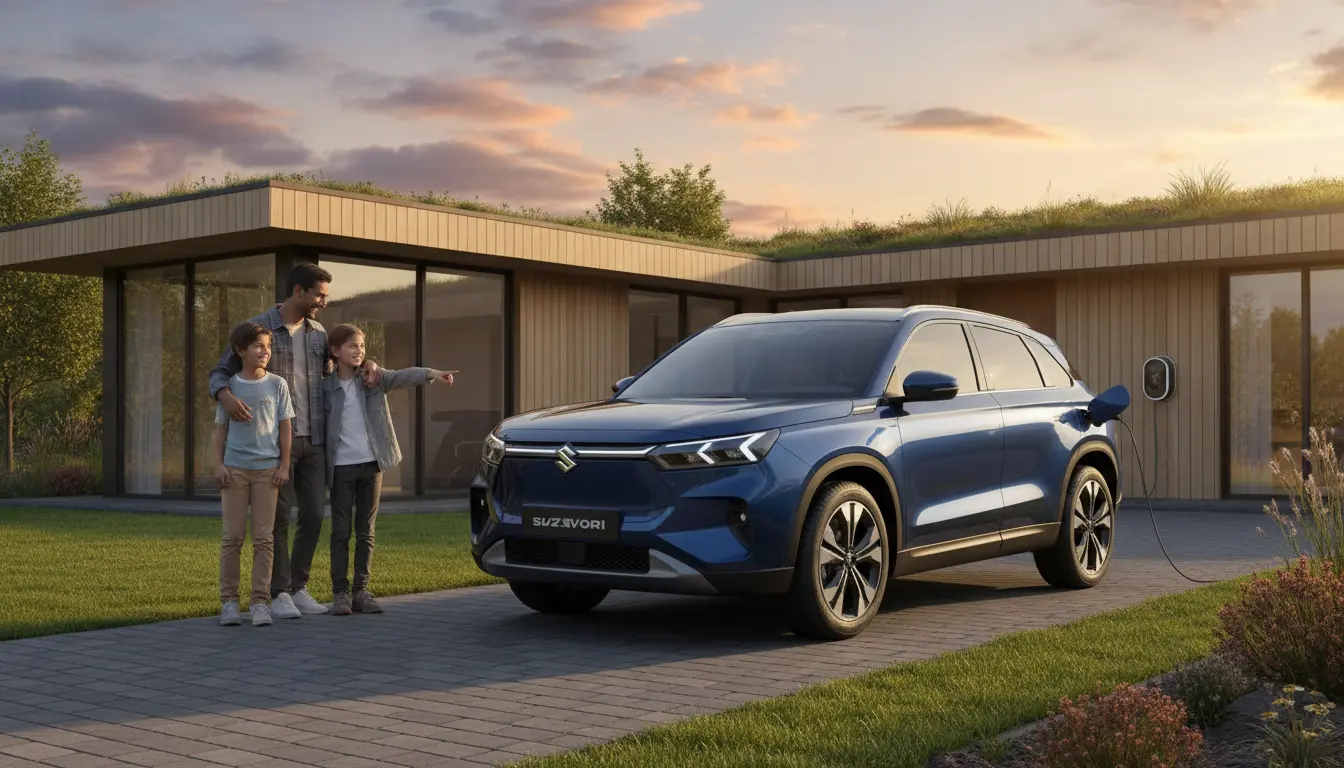
Overview of the 2026 Maruti Suzuki e Vitara
The 2026 Maruti Suzuki e Vitara is positioned as a compact electric SUV aimed at families who want practical range, interior space, and low running costs. It targets urban and suburban households that need a comfortable daily driver with occasional longer trips.
This article explains the e Vitara in practical terms: expected specs, charging, costs, safety, and ownership tips you can use when deciding if it fits your family needs.
Key specs and performance of the 2026 Maruti Suzuki e Vitara
Below are the likely headline figures and the real-world meaning for families considering the 2026 Maruti Suzuki e Vitara.
- Battery and range: expected 50–60 kWh usable battery and 300–420 km real-world range depending on driving style and climate.
- Powertrain: single-motor front-wheel-drive with around 120–150 kW peak power for smooth everyday performance.
- Charging: AC home charging (7–11 kW) and DC fast charging support up to 100 kW for rapid top-ups.
- Practical weight and size: compact SUV footprint with seating for five and flexible boot space for strollers or weekend luggage.
What the specs mean for daily family use
Range figures in the 300–420 km band are sufficient for typical weekly family use and city commuting. A full charge at home will cover most weeks for families that drive 30–60 km per day.
Fast charging is useful for road trips and long weekend drives. Expect a practical recharge workflow of overnight home charging plus occasional DC fast charging stops.
Interior, safety, and family-focused features
The 2026 Maruti Suzuki e Vitara is likely to focus on safety, space, and convenience features that matter to families.
- Cabin: flat floor feel, adjustable rear seats, and ISOFIX anchors for child seats.
- Safety tech: ADAS level features such as autonomous emergency braking, lane assist, and adaptive cruise control are expected to be available.
- Infotainment and connectivity: large touchscreen with smartphone mirroring, multiple USB-C ports, and over-the-air updates for software improvements.
Charging at home and on the road for the 2026 Maruti Suzuki e Vitara
Understanding charging options helps estimate daily routines and costs. Most families will rely on home charging as the primary source.
- Home charging: a wallbox 7 kW charger typically fills a 60 kWh battery overnight (6–8 hours).
- Public AC charging: useful for daytime top-ups at shopping centers or workplaces.
- DC fast charging: allows 20–80% charge in about 25–40 minutes depending on the battery and charger power.
Tip: Planning charging for family trips
Map charging stops before long drives and pick locations with family facilities like restrooms and cafes. Aim to schedule a 20–40 minute stop every 200–300 km to recharge and rest.
Running costs and savings for the 2026 Maruti Suzuki e Vitara
Electric vehicles typically have lower per-kilometer energy costs and fewer routine maintenance needs. Here is a practical way to estimate savings.
- Energy use: assume 14–18 kWh per 100 km in mixed driving. Lower consumption helps extend range and reduce running costs.
- Maintenance: EVs have fewer moving parts, which reduces service visits for oil, belts, and clutches.
- Resale and incentives: government incentives and lower running costs can improve total cost of ownership.
Example cost comparison
For a household that drives 12,000 km per year: at 16 kWh/100 km, annual energy use is about 1,920 kWh. At an average electricity rate of 10 currency units per kWh, annual energy cost would be approximately 19,200 units. Compare that to petrol costs for a similar petrol SUV and you can quickly see potential savings.
Practical buying considerations for the 2026 Maruti Suzuki e Vitara
When evaluating the e Vitara, consider these practical points to match the car to family needs.
- Daily range needs and available home charging setup.
- Space for child seats and cargo. Check the rear-door opening width and boot flexibility.
- Service and warranty: battery warranty length and coverage for higher-voltage components.
- Dealer network and availability of public chargers along common routes.
Real-world case study: Family in Pune choosing the 2026 Maruti Suzuki e Vitara
Rahul and Ananya, a family of four in Pune, switched from a small petrol SUV to the e Vitara as their daily car. Their commute is 35 km round trip and they do two longer trips each month.
They installed a 7 kW home charger and typically charge overnight. With an average energy use of 15 kWh/100 km they cover daily driving without mid-week charging. On weekend trips they use DC fast chargers at highway plazas for quick top-ups.
After a year they reported simpler servicing, lower monthly running costs, and the convenience of charging at home. Their decision hinged on reliable dealer support and a useful range for their routine.
Final checklist before you buy the 2026 Maruti Suzuki e Vitara
Use this checklist to compare models and trim levels objectively:
- Real-world range at your typical speeds and climate conditions.
- Warranty on battery and EV components.
- Charging equipment included and recommended home charger options.
- Dealer network, service intervals, and parts availability.
- Safety feature availability and child-seat compatibility.
Choosing an electric family SUV like the 2026 Maruti Suzuki e Vitara means balancing range, charging convenience, and interior practicality. For many families, the combination of lower running costs and modern safety features makes an EV a sensible replacement for a traditional petrol SUV.