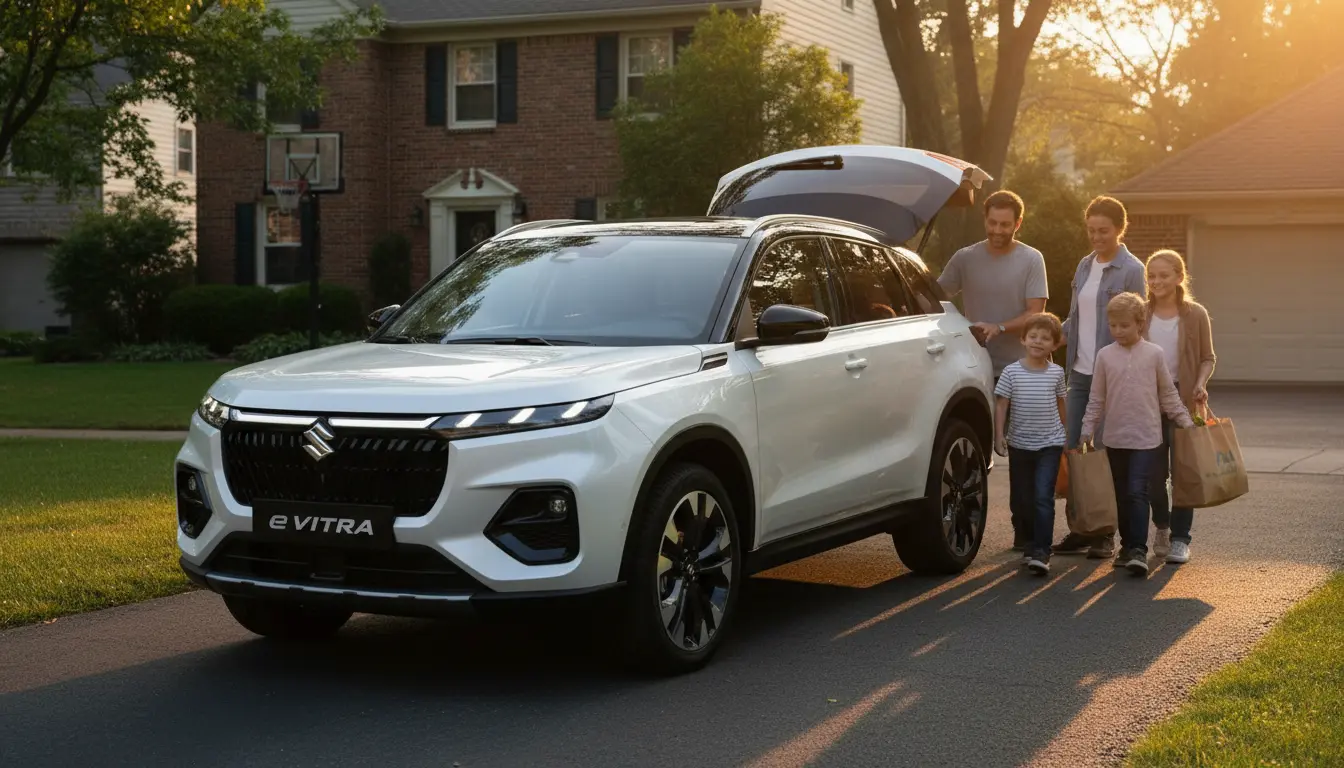
Overview of the 2026 Maruti Suzuki e Vitara
The 2026 Maruti Suzuki e Vitara is a compact electric SUV aimed at families seeking a practical, efficient daily driver. It blends conventional SUV space with modern EV systems to meet urban and suburban needs.
This article breaks down the main features, real ownership costs, charging options, safety, and how the e Vitara fits family life. The goal is to give clear, usable information for buyers making a practical decision.
Key specifications of the 2026 Maruti Suzuki e Vitara
Specifications help set expectations before a test drive. Below are the headline numbers prospective buyers check first.
- Battery options: two pack sizes (estimated 48 kWh and 64 kWh)
- Range: approximately 300–450 km WLTP depending on battery and trim
- Charging: 7–11 kW AC onboard charger; 80% in 30–45 minutes on DC fast charge
- Power: motor outputs around 120–160 kW for quicker trims
- Seating: 5 adults, flexible boot space with rear seats folded
Design and space for modern families
e Vitara keeps a familiar SUV silhouette with a higher seating position and wide doors. Interior packaging focuses on usable storage and simple controls for everyday use.
Rear-seat room and a flat floor layout make child seats and booster cushions easier to install. Boot volume is competitive for the class when seats are upright and grows when folded for longer trips.
Interior features and practical touches
Expect family-friendly touches such as multiple USB ports, cup holders, door pockets, and an optional roof rail for extra luggage. The infotainment system includes smartphone integration and vehicle energy monitoring.
Battery, range, and charging for family life
Battery capacity and real-world range matter most to families who plan weekly trips or school runs. The e Vitara’s larger battery aims to reduce range anxiety while keeping costs reasonable.
Typical charging scenarios
- Home charging (AC 7–11 kW): overnight top-up for daily use, typically 8–12 hours from low to full.
- Workplace charging: useful for topping up during the day if available.
- Public DC fast charging: adds 200+ km in 30–45 minutes for longer journeys.
Families who install a 7 kW home charger can expect convenient routines: plug in overnight and start each day near full.
Technology and safety in the 2026 Maruti Suzuki e Vitara
The e Vitara includes modern active safety and driver assistance features. These support daily driving and reduce stress in busy traffic.
- Advanced driver assistance: lane keep assist, adaptive cruise, and automatic emergency braking.
- Passive safety: multiple airbags, reinforced body structure, and ISOFIX child seat anchors.
- Convenience: digital cluster, energy flow display, and remote app features for pre-conditioning and charge scheduling.
Which safety features matter most for families?
Focus on ISOFIX anchors for secure child seats, robust crash structure, and driver assistance that reduces the risk of low-speed collisions. Remote climate pre-conditioning is helpful on hot or cold days to make the cabin safe and comfortable for kids before boarding.
Ownership costs and practical running numbers
Electric vehicles tend to have lower running costs due to reduced maintenance and lower per‑km energy costs compared with petrol. The e Vitara follows this trend while offering predictable servicing intervals.
- Energy cost example: if electricity costs 8–12 INR/kWh, a 100 km trip can cost a fraction of petrol equivalents.
- Maintenance: fewer moving parts, no oil changes, and longer brake pad life due to regenerative braking.
- Residual value: depends on battery warranty and perceived range; manufacturer warranty terms matter.
Practical buying checklist for families
Before committing, evaluate how the e Vitara fits your routine. Use this checklist during a test drive or dealership visit.
- Daily commute distance and typical weekend trip lengths
- Access to home or workplace charging
- Child seat installation and rear-seat space verification
- Real-world range test at your usual driving speeds and climate
- Local service centre availability and battery warranty terms
Case study: A family test drive and first three months
Ravi and Ananya, a family of four in Pune, tested the e Vitara for three months to evaluate daily usability. Their commute is 40 km round-trip, and they do one 250 km weekend trip per month.
They installed a 7 kW home charger and charged mostly overnight. On workdays, they reached 95–100% state of charge each morning. Their monthly energy cost dropped by roughly 60% compared with their previous petrol SUV.
- Average daily range used: 40–50 km
- Weekend long trip: used a public DC fast charger and reached 80% in 35 minutes
- Practical note: rear seat room was sufficient for two child seats and a booster simultaneously
After three months they reported lower running costs, simpler maintenance, and satisfaction with cabin space. They recommended checking real-world range on local roads during test drives.
Final considerations: Is the 2026 Maruti Suzuki e Vitara right for your family?
The e Vitara balances everyday practicality, modern EV efficiency, and family-friendly features. It is best suited for families with reliable access to home or workplace charging and for those seeking lower running costs.
If your driving includes frequent long trips in remote areas with limited fast charging, evaluate route charging options and consider the larger battery variant. For most suburban and urban families, the e Vitara will be a sensible, cost-effective choice.
Next steps
Arrange a test drive, measure real-world range on your typical routes, and confirm home charger options and local support. Use the checklist above to compare trims and warranties before purchase.